Guests at a seated dinner spend two or three hours looking at the middle of the table. That makes the centrepiece the one design choice every person in the room studies at length, and the style you pick has to suit your table shape, your ceiling height and your budget before it can suit your taste.
Flowers are also where budgets drift. The Knot's Real Weddings Study figures on flowers put the average couple's spend at US$2,800, and that covers bouquets, boutonnières and centrepieces together. Centrepieces are the line that multiplies, because every choice is repeated across every table.
Key Takeaways
- Compote centrepieces run about $150 to $295 CAD per table and sit below eye level on any standard 60-inch round
- Garden runners run about $350 to $600 CAD per 8-foot table; put them on the head table and family tables, simpler pieces on the rest
- Bud vase clusters, at about $80 to $180 CAD per table, cover every table for the cost of three or four full centrepieces
- Tall candelabras, about $300 to $550 CAD per table with rental, need clamped bases and the venue's rules on open flame
- Low-and-lush mounds, about $120 to $300 CAD per piece, depend on peonies (June) or dahlias (August to first frost) to look their best
- In-season stems cost less than imports, so choose the style after you know your date
All five styles work for a wedding reception or a dinner party at home. If you are hosting the second, the art of the dinner party covers the rest of the table, from linens to the seating plan.
1. The Compote Centrepiece
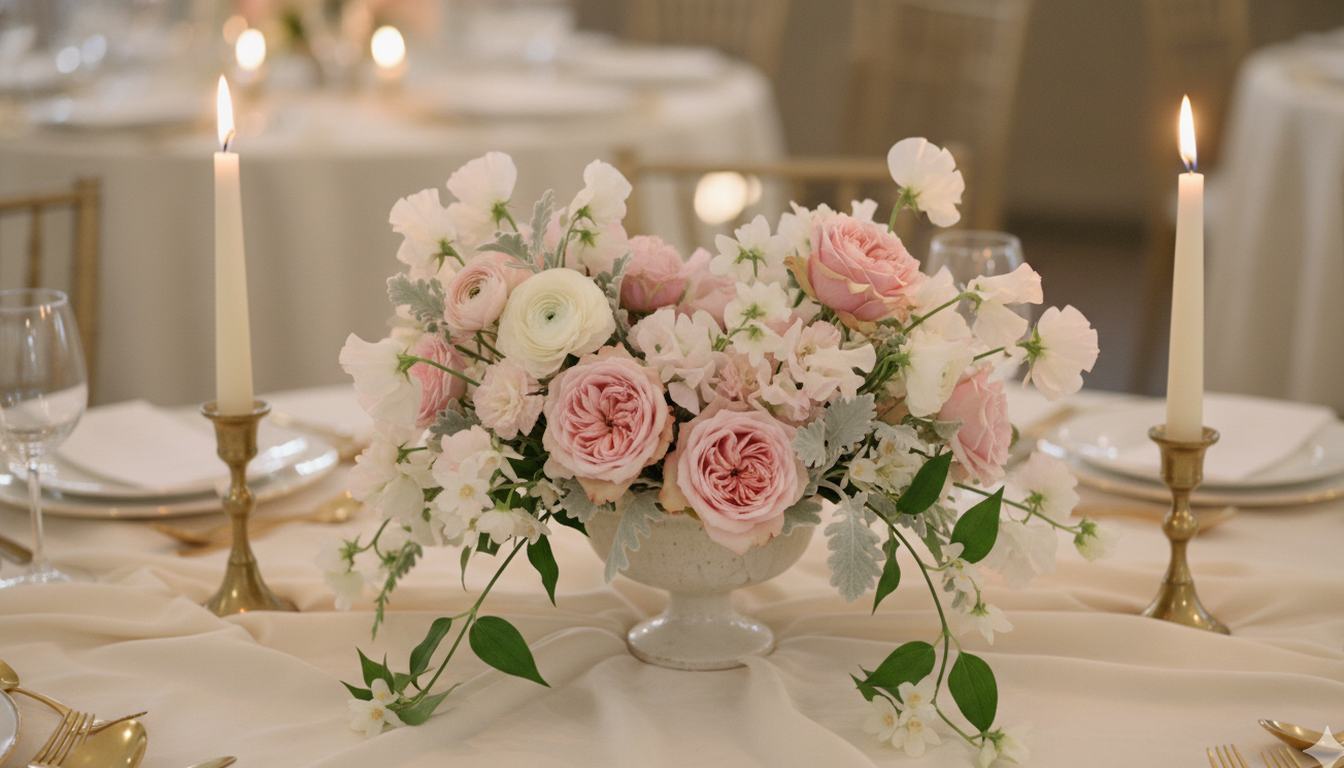
A footed bowl in ceramic, glass or burnished metal holds a domed arrangement that crests just above the rim: blush garden roses, white ranunculus, pale lisianthus and a few tendrils of jasmine vine softening the edge. The whole piece stays around 14 inches high. The pedestal gives it lift without creating a wall between guests, so the flowers are lovely and the people across the table are still the point.
The compote is the workhorse. It suits a ballroom with 16-foot ceilings and a barn with exposed beams, and it sits on a 60-inch round without crowding a plate or a wine glass. If you are unsure where to start, start here.
Flowers, season and table fit
Garden roses carry it. Juliet and Keira, with their cupped, many-petalled heads, are two of my favourites in a compote. Ranunculus, lisianthus and sweet peas add lightness, and trailing jasmine gives the edge some movement. For foliage, dusty miller's silvery texture makes everything next to it look richer; eucalyptus gives a more structured shape. Skip stiff salal, which pushes the look toward a hotel lobby.
Sweet peas are a late-spring flower, so if you love them, that is a reason to pick a June date. Greenhouse garden roses are available all year, though local ones peak in early summer. Ranunculus is best in spring and early summer; after that it is imported and costs more.
A compote is designed for a 60-inch round, which seats eight to ten. On a 66-inch round, choose a wider vessel. On an 8-foot rectangular table a single compote looks underdressed, so flank it with bud vases every 18 to 24 inches or with low tapers.
For candles, two or three beeswax tapers in slim brass holders beside the compote, with a few votives around the base. Leave out tall pillars. They compete with the arrangement for height and clutter the table.
Cost: about $150 to $295 CAD per table. It photographs well from every side, which matters because your photographer will shoot the table details. If I had to choose one style for a reception, it would be this one.
2. The Garden Runner
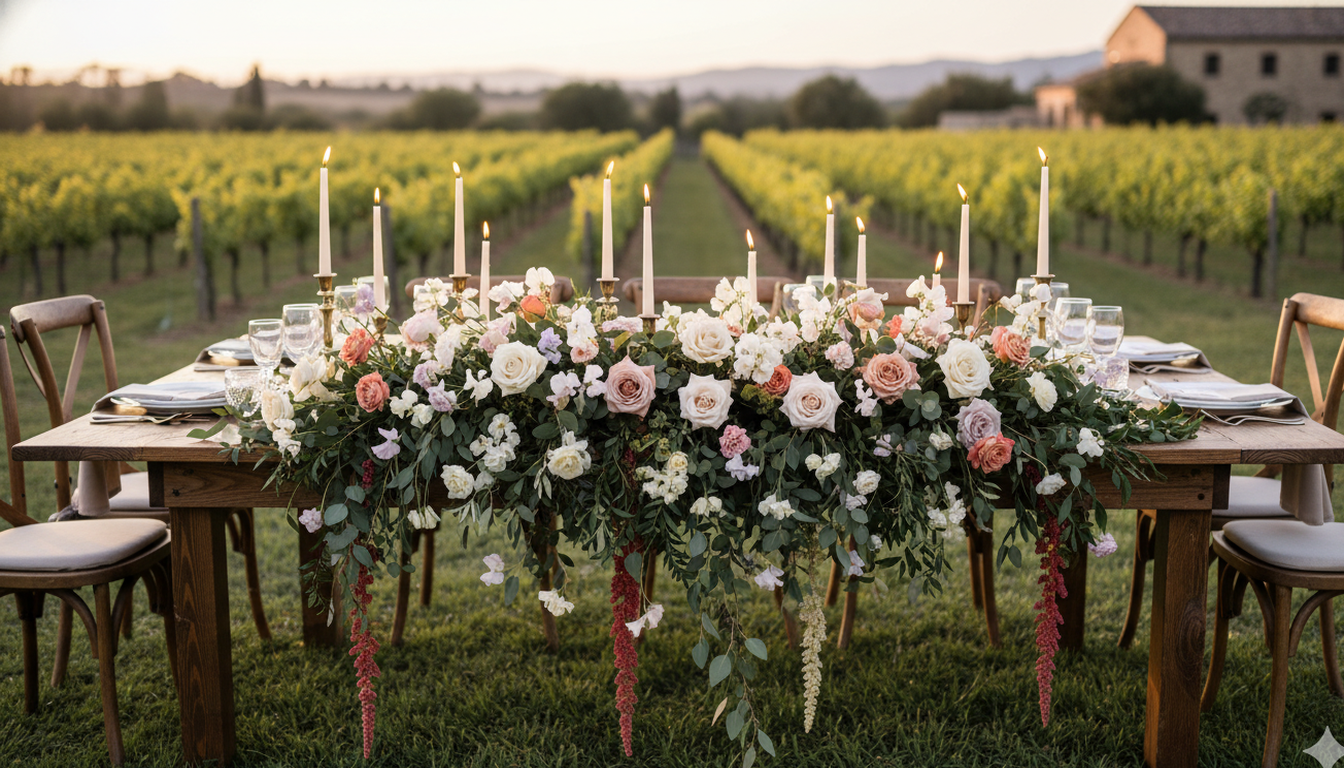
A long farm table under string lights, eucalyptus and Italian ruscus spilling over the edges, garden roses in blush and apricot tucked between the greenery, three brass candlesticks at different heights woven through it all. Burgundy amaranthus trails off the corners like an old Dutch still life. That is a garden runner.
A runner is not a garland you unroll from a box. It is built fresh, stem by stem, on the table itself, using water tubes (small water-filled capsules) that keep each stem hydrated through a four-hour dinner. Your florist assembles it on site in the two to three hours before guests sit down, so florist access time belongs in the venue agreement and the day-of timeline.
Flowers, season and table fit
Eucalyptus and Italian ruscus form the base, since both drape naturally and hold their shape lying flat. Garden roses in two or three related shades anchor the colour, with ranunculus, sweet peas and anemones for texture. Trailing amaranthus adds drama at the ends: green reads lush, burgundy reads bold. Lemon leaf and ferns add depth without bulk.
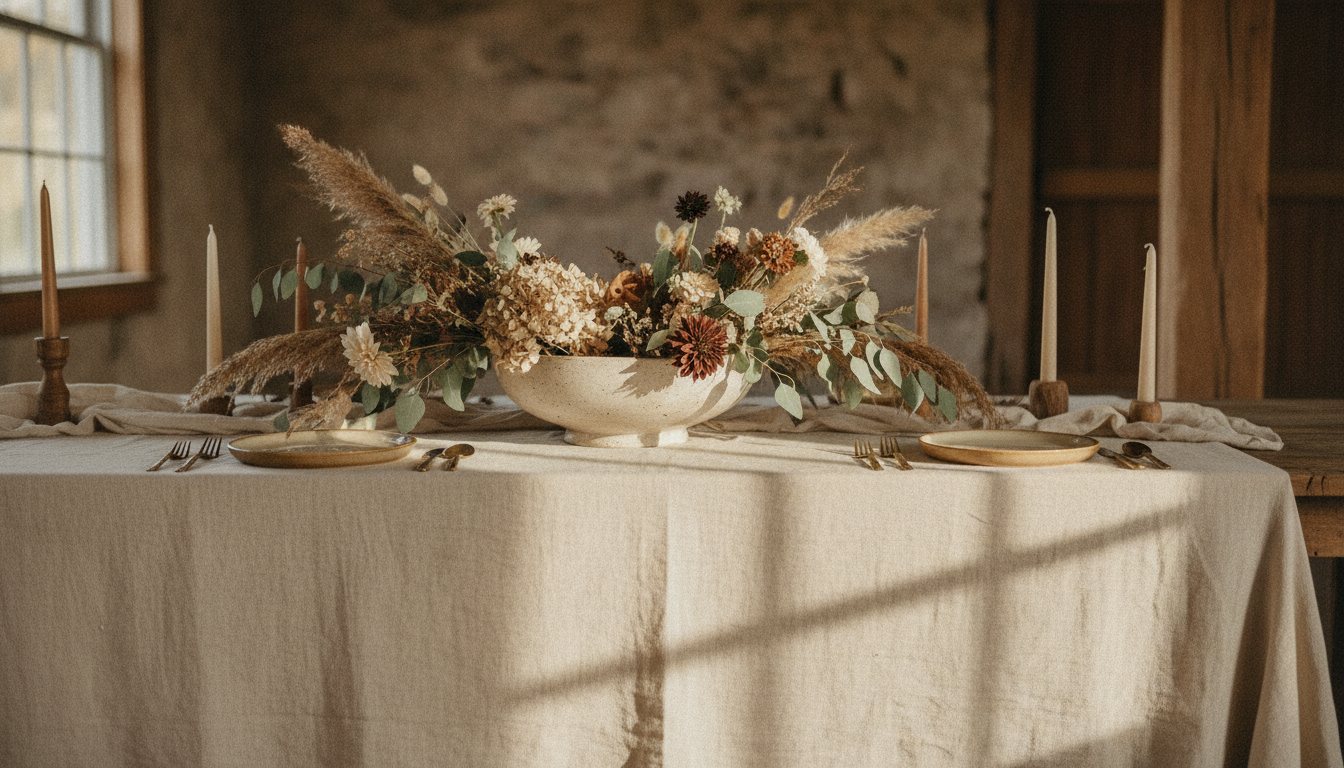
In spring, sweet peas and ranunculus with eucalyptus make one of the prettiest tables you can set. In summer, build around dahlias, lisianthus and local roses. In fall, mix dried pampas, cotton stems and preserved eucalyptus with chrysanthemums and the last dahlias before frost.
Runners belong on rectangular and farm tables only. An 8-foot farm table is the ideal canvas; a 6-foot table takes a shorter, denser run. On a 60-inch round there is nowhere for a runner to go.
For candles, pillars in low hurricane glass, or brass candlesticks woven into the greenery. For an evening reception, tuck tea lights between the stems along the full length.
- Ask the venue whether it charges a florist access fee for early setup, and what it is
- Confirm the setup window in writing with both the venue and the florist
- Cost: about $350 to $600 CAD per 8-foot table
This is the splurge. Fifteen tables at $500 is $7,500 before a single boutonnière. My suggestion: put runners on the head table and the family tables, and use compotes or bud vases everywhere else. The head table is where the photographs cluster anyway, so most of the impact survives at a fraction of the cost. Building a realistic wedding budget shows where that saving can go.
3. The Tall Candelabra
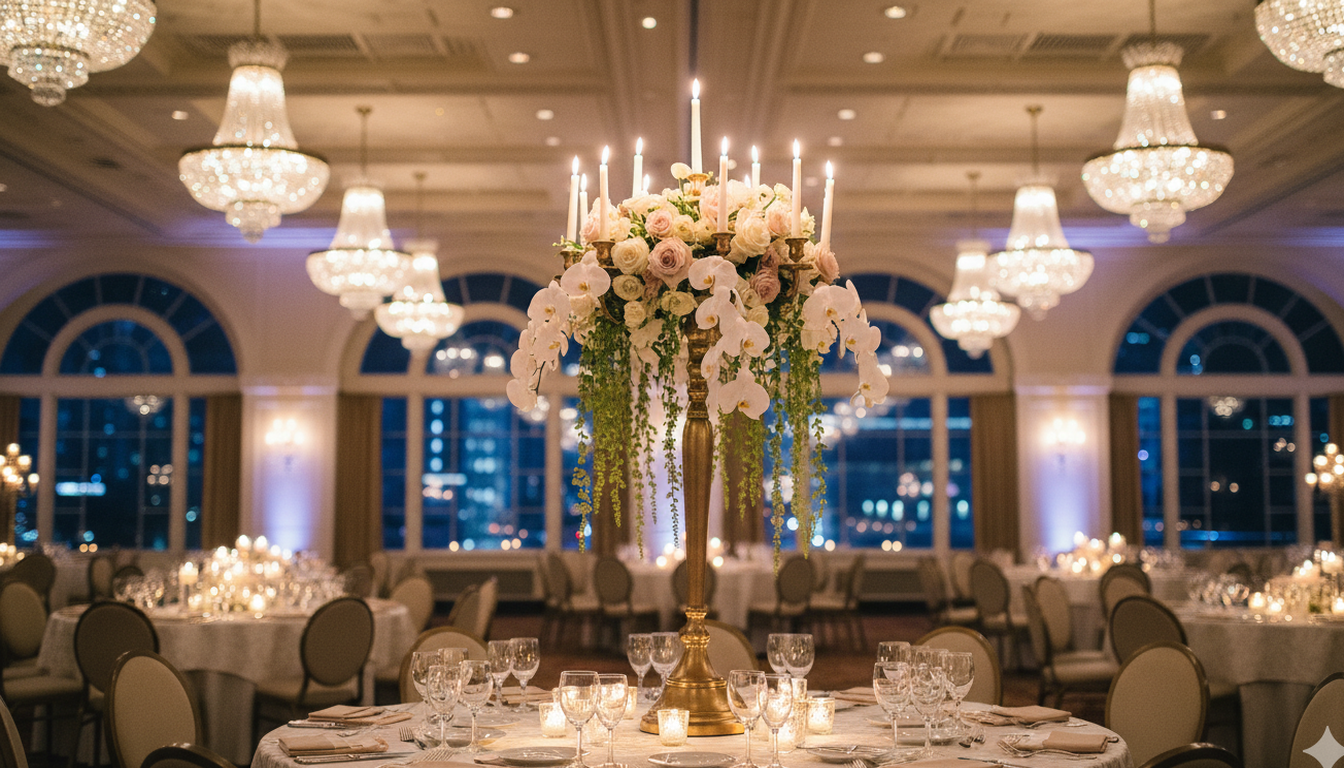
For drama in a big room, nothing matches it. Tall gold candelabras with white phalaenopsis orchids cascading from the crown and green amaranthus draping down, candles glowing overhead, and the space below completely clear for conversation. In a ballroom with high ceilings the proportions feel right. In a low room they feel cramped, so check the ceiling before you fall for the photos.
Because the flowers sit well above head height, guests see each other across the table with no effort. The rule is simple: the floral mass has to clear seated eye level. If the bulk sits at face height, it blocks the table and defeats the purpose.
Flowers, season and table fit
Phalaenopsis orchids give the cascading sweep that makes this style distinctive. Garden roses and lisianthus fill the crown, and hanging amaranthus in green or burgundy supplies the trailing length. For a more modern take, use protea or garden roses in one saturated colour, such as deep red, burnt orange or ivory.
Orchids are greenhouse flowers with no season, which makes them dependable for any date. Local garden roses and amaranthus are summer flowers. For a winter or early spring date, lean on orchids and greenhouse roses and use dried trailing stems for length.
Candelabras suit round tables for eight or more, where the visual weight radiates evenly. On long tables, space them well apart, roughly every 8 feet, or the repetition turns heavy.
For candles, the candelabra's own candles are the only ones the table needs. Adding tapers below turns it into a candle shop. If the venue requires LED candles, choose good warm-flicker LED tapers; cheap ones look like exactly what they are.
Cost: about $300 to $550 CAD per table, including candelabra rental.
Ask your florist about a flip: the crown comes off after dinner and moves to a low vessel for the dancing, which gives you two looks from one set of flowers.
Safety comes first
A bumped table can tip a tall candelabra, and a lit candle close to petals is a fire risk. Insist on these before a single guest sits down:
- The base is clamped or weighted to the table, not balanced on top
- Each candle is fixed in its holder with wax adhesive so nothing wobbles
- Flowers are kept well clear of every flame, and the florist follows the venue's rules on open flame
- LED candles wherever the venue or the local fire rules require them
- Someone checks the stability of every candelabra before guests are seated
A careful florist and rental company handles all of this without being asked. If yours does not raise it, raise it yourself.
4. The Bud Vase Cluster
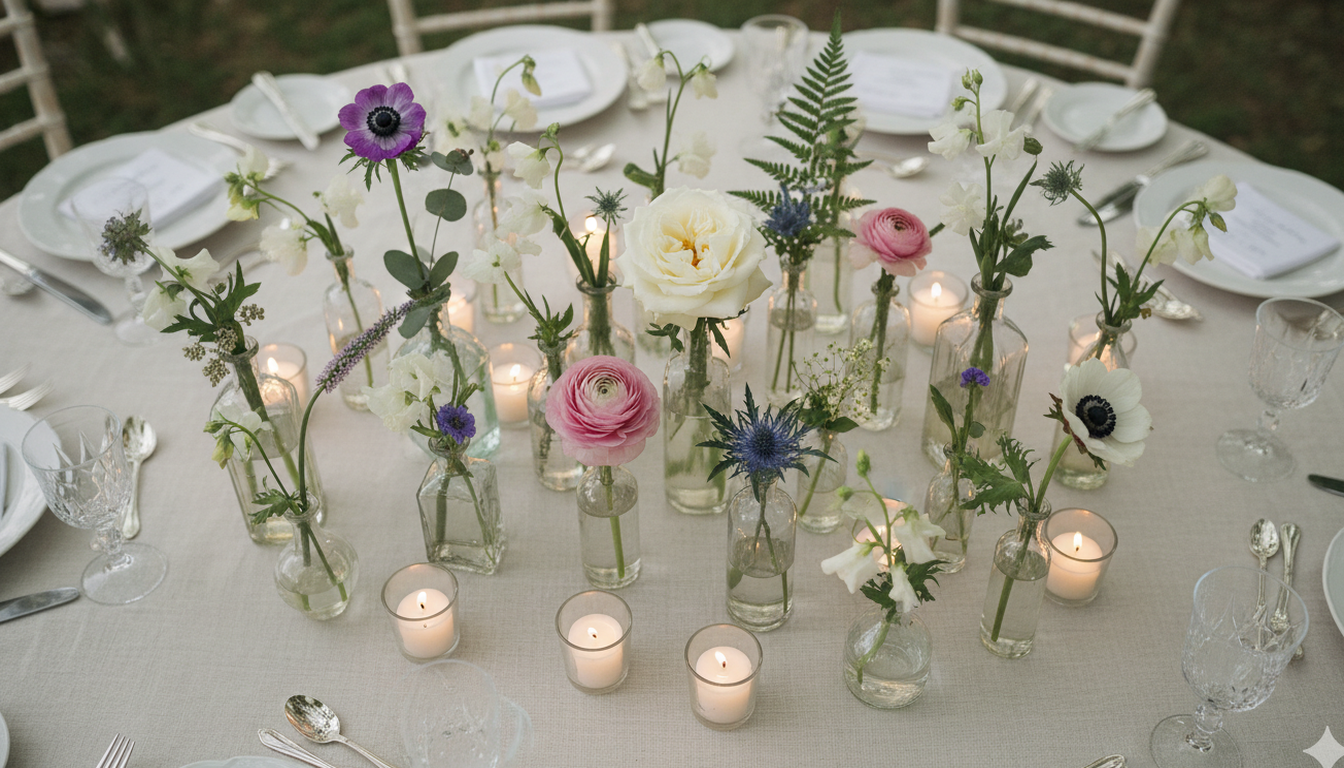
Five to twelve small vessels of different heights, glass bud vases, vintage bottles, little coupes, a ceramic bud vase or two, grouped in the centre of the table, each holding a stem or two, with votives flickering between them. It looks effortless in the way only something carefully considered can. Abundance without extravagance.
Think of it as a constellation: each vessel is a star, and together they make the shape. It suits intimate and garden weddings, and it is the most budget-friendly option here by a wide margin.
Flowers, season and table fit
The whole point is variety. Each vessel holds something different: a single Caramel Antike garden rose, cream ranunculus, pale lavender scabiosa, pink sweet peas, deep purple lisianthus, an anemone with its dark centre, a cosmos leaning on a long stem. Don't over-coordinate it. The mix is the charm.
The vessels matter as much as the stems. Clear glass beside brown vintage bottles and a small coupe gives the cluster depth. Matching vessels look like a product display; mismatched ones look like a story.
Because every vessel holds its own stem, this style takes whatever is in season. Spring: sweet peas, ranunculus, tulips, anemones. Summer: cosmos, zinnias, scabiosa, dahlias. Fall: dahlias, dried pampas, cotton stems and late rudbeckia.
It works on round and rectangular tables alike. On a 60-inch round, keep the group about 18 inches across. On an 8-foot table, stretch it into a loose line three to four feet long, some vessels close together and some apart.
For candles, six to ten votives and a few short tapers placed through the cluster, part of the constellation rather than beside it.
- Nothing stands taller than about six inches, so there are no sight-line problems
- Vessels can be rented from the florist, bought, or found at vintage shops
- Cost: about $80 to $180 CAD per table
For a 200-guest wedding on a tight floral budget, this is the answer. You cover every table with something lovely for the cost of three or four full compotes, and because each table differs slightly, the room feels personal rather than repeated. It is the style I would point anyone toward who wants flowers that look like a dream on a real-world budget.
5. Low and Lush (The Flower Mound)
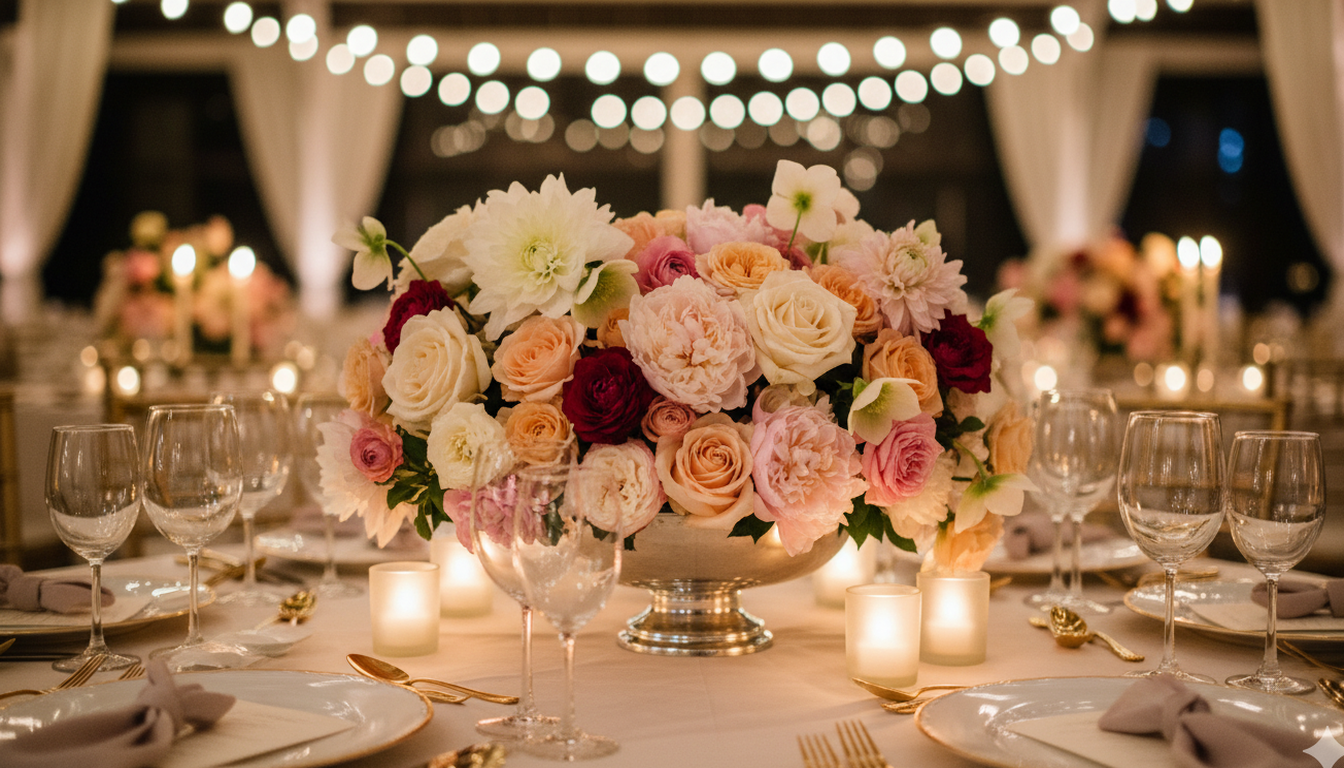
Where the compote is elegant and the runner is abundant, the low-and-lush is sumptuous. A wide, shallow vessel (a low bowl, a wooden trough, a stone dish) packed tight with many-petalled flowers: garden roses in three shades sitting cheek to cheek, blush peonies opening in layers, ranunculus in every gap, white dahlias adding their spiralling form. Almost no greenery shows. The mound sits six to eight inches above the table, and guests lean in for a closer look.
Flowers, season and table fit
This style needs full, heavy blooms. Mix garden rose varieties for tonal depth; Juliet in apricot, Keira in pink and White O'Hara in cream work well together. Peonies are the prize when they are in season, and a bowl massed with peonies is one of the most beautiful things you can put on a table. Ranunculus and dahlias add other forms, and hellebores give a spring mound a moody note. Leave out airy stems like cosmos, Queen Anne's lace and sweet peas; they look lost in the density. Save them for bud vases.
Peonies and dahlias make this style, and both are seasonal. In southern Ontario, peonies are a June flower. Dahlias run from August until the first hard frost, which is often in October. Outside those windows, build on garden roses and ranunculus and add lisianthus for volume.
A mound reads well from every side of a 60-inch round. On an 8-foot table, space two or three along the length, with low votives in between.
For candles, ten to twelve tea lights around the base, not tall tapers. The mound already carries a lot of visual weight, and tall candles make the table busy.
- The high stem count means more labour than a compote of the same width
- Cost: about $120 to $300 CAD per piece, depending on flowers and density
I like where this style sits right now: density and richness over the loose, wild meadow look. A table where you can barely see the vessel under the flowers reads as a decision, made and committed to.
Seasonal Flower Cheat Sheet
A florist can source almost anything year-round through importers, and sometimes an import is the right call. Local stems, though, have spent less time in transit and cold storage, and they skip international freight. This is a general guide for southern Ontario, including Northumberland County, Ontario; a local grower or your florist will know the exact weeks for your year.
Late spring (May and June)
peonies, tulips, ranunculus, sweet peas, lilacs, anemones, hellebores, hyacinths, narcissus, fritillaria. The richest range of soft pinks, creams and lilacs of the year. Sweet peas are strictly a late-spring flower.
Summer (July to September)
dahlias, zinnias, lisianthus, cosmos, scabiosa, sunflowers, rudbeckia, celosia, snapdragons, statice, echinacea. The most abundant season for local stems. Dahlias peak in late summer; for a summer reception, build around them.
Fall (October and November)
dahlias until the first hard frost, chrysanthemums, marigolds, dried pampas, branches in turning colour, cotton stems, dried seed heads, preserved eucalyptus. Amber, rust and burgundy work with the season rather than against it.
Year-round (greenhouse and import)
roses, hydrangeas, carnations, snapdragons, orchids, protea, leucadendron, spray roses. These fill arrangements when local supply is thin.
A word for carnations. Grocery-store carnations are a sad thing. Ruffled garden types such as Chabaud are a different flower altogether, and they usually cost less per stem than garden roses. Ask your florist about them before you write off the whole category.
For how each flower looks, what it traditionally means and what it costs, see the best flowers for your wedding. To carry the table flowers into the bouquets, see the 2026 bouquet styles, and to choose the colours first, the 2026 wedding colour palettes.
Questions to Ask Your Florist Before You Book
A florist consultation goes better when you arrive with the questions that shape the quote. These are the ones worth asking:
About the quote
- What is included: flowers, vessels, delivery, setup and teardown?
- Is there a separate labour charge for building arrangements on site, such as garden runners?
- Is there a minimum order or a delivery fee?
- Are vessels included, or rented on top?
About the flowers
- Are these stems locally grown or imported, and from where?
- If a variety is unavailable on my date, what will you substitute, and will I see the substitution in writing first?
- Can you source this flower in season for my date, or will it be a greenhouse or imported stem?
About timing
- When will you confirm the final flower list?
- How long before the event will the flowers be cut and stored?
- How many hours do you need on site before guests are seated?
- Do you handle teardown and vessel pickup, or does the venue?
- Have you worked at my venue before, and does it restrict open flame, confetti or setup times?
About the money
- If I use simpler arrangements on some tables, how does the total change?
- Can ceremony flowers move to the reception?
A florist who answers these clearly and without defensiveness respects your money and your time. For the same kind of list covering every other vendor, see the questions to ask your wedding vendors.
Related Reading
- The Art of the Dinner Party: the rest of the table, from linens to the seating plan.
- 7 Wedding Colour Palettes for 2026 by Season and Venue: pick your colours first, then choose florals that carry them.
- 5 Wedding Planning Mistakes and How to Avoid Them: including the budget maths behind flowers and vendor costs.
Ali Rose Events Co.'s Signature Bloom package includes vendor sourcing, budget tracking and a timeline, so matching a florist to your table plan is part of the work. See the planning packages or book a consultation to talk through arrangement styles for your venue, your table layout and your budget.